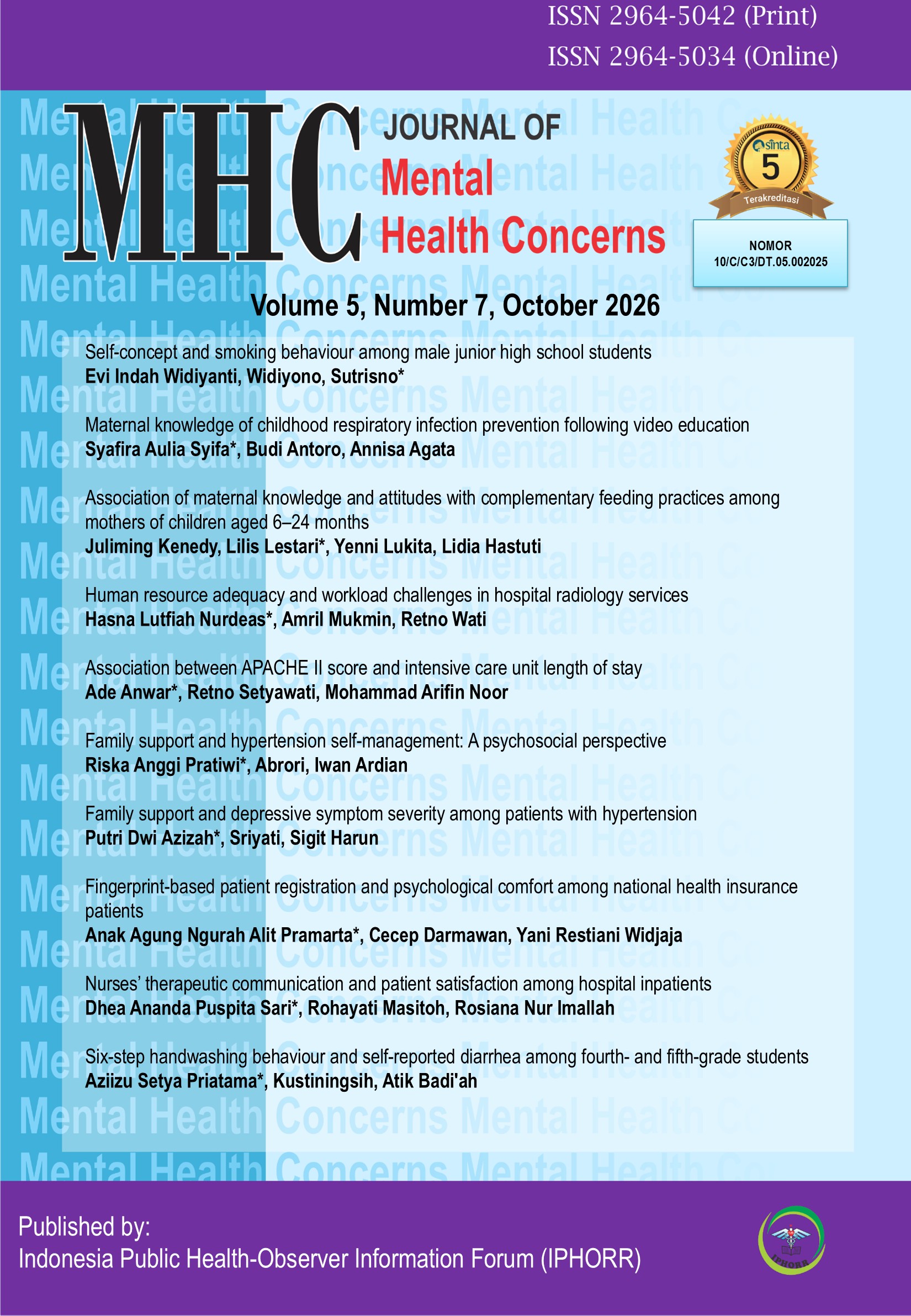
Fingerprint-based patient registration and psychological comfort among national health insurance patients

DOI: https://doi.org/10.56922/mhc.v5i7.4559
Fingerprint Technology National Health Insurance Patient Registration Service Effectiveness SERVQUAL
Abstract
Background: Registration efficiency remains an important concern in hospitals, particularly for patients enrolled in Indonesia’s National Health Insurance program, administered by Social Security Administrator for Health. Fingerprint technology supports patient identification, but registration service effectiveness may also be associated with service quality.
Purpose: To examine the associations between service quality dimensions and perceived effectiveness of fingerprint-based patient registration.
Method: This quantitative study used an associative explanatory approach with a cross-sectional design. A total of 100 NHI patients were selected using purposive sampling. Data were collected using a five-point Likert-scale questionnaire covering reliability, responsiveness, assurance, empathy, and tangibles, alongside direct observation of registration time. Multiple linear regression was used, with statistical significance set at p < 0.05.
Results: Mean registration time was 182.22 ± 5.22 seconds. The regression model was statistically significant (F = 11.688, p < 0.001). Empathy (p = 0.004) and tangibles (p < 0.001) showed positive, statistically significant associations with perceived service effectiveness. Reliability (p = 0.257), responsiveness (p = 0.525), and assurance (p = 0.343) were not statistically significant individual predictors.
Conclusion: Perceived registration service effectiveness was associated with empathy and tangibles. Improving staff–patient interactions and maintaining adequate registration facilities may support better service experiences. The observed registration time alone does not establish that fingerprint technology reduced registration duration.
Keywords: Fingerprint Technology; National Health Insurance; Patient Registration; Service Effectiveness; SERVQUAL.
Downloads
References
Amabi, M. S., Marchamah, D. N. S., & Arumsari, W. (2025). Evaluasi Penggunaan Fingerprint Sebagai Upaya Pencegahan Fraud Pada Peserta BPJS Rawat Jalan Di RSIA X Kupang. Indonesian Journal of Health Community, 6(2), 108-122. doi.org/10.31331/ijheco.v6i2.3788
Anggriani, S. W. (2016). Kualitas pelayanan bagi peserta BPJS Kesehatan dan non BPJS Kesehatan. JISIP: Jurnal Ilmu Sosial dan Ilmu Politik, 5(2), 79–84. doi.org/10.33366/jisip.v5i2.249
Arifiani, H., & Gunawan, E. (2025). Analysis of Fingerprint Usage to Support the Effectiveness of SSAH Patient Services in the Emergency Department (IGD). International Journal Prima Husada Health (IJPHH), 2(1), 123-129. doi.org/10.55963/ijphh.v2i1.2495.
Aryanti, U., Sunusi, S. L., & Wahid, A. (2025). Penggunaan aplikasi mobile NHI dalam mendukung efisiensi proses self check-in pasien BPJS di Siloam Hospitals Makassar. Teknologi dan Aplikasi Berbasis Edukasi dan Civitas (TABEC), 2(1), 14-20.
Christasani, P. D., & Satibi, S. (2016). Kajian Faktor Demografi Terhadap Kepuasan Pasien Jaminan Kesehatan Nasional Pada Fasilitas Kesehatan Tingkat Pertama. Jurnal Farmasi Sains dan Komunitas (Journal of Pharmaceutical Sciences and Community), 13(1), 28-34. doi.org/10.24071/jpsc.00127
Dani, M., Silitonga, T. D., Paramita, R., & Ricardo, R. (2025). Efektivitas Penggunaan Fingerprint Terhadap Pasien Jaminan Badan Penyelenggara Jaminan Sosial (BPJS) Kesehatan Di Rumah Sakit Bina Kasih Pekanbaru Tahun 2024. Jurnal Rekam Medis (Medical Record Journal), 4(1), 33-40. doi.org/10.25311/jrm.Vol4.Iss1.1377
Ekawati, R., Wintara, D., & Nurhalimah, N. (2020). Kualitas pelayanan bagi peserta SSAH kesehatan dan non SSAH kesehatan. Proceeding FRIMA (Festival Riset Ilmiah Manajemen dan Akuntansi), (1), 483-494. doi.org/10.55916/frima.v0i3.317
Fadly, F., & Vianny, O. (2019). Pemanfaatan jaminan kesehatan nasional (JKN) Tahun 2018 di Provinsi Riau. Jurnal Kebijakan Kesehatan Indonesia: JKKI, 8(4), 164-167. doi.org/10.22146/jkki.49113
Hafidzah, F., Hasibuan, R., & Agustina, D. (2025). The Relationship Between Registration Time and Outpatient Satisfaction at Dr. Tengku Mansyur Tanjungbalai Hospital. MEDFARM: Jurnal Farmasi dan Kesehatan, 14(1), 141-150. doi.org/10.48191/medfarm.v14i1.571
Kholis, K. N., Ellynia, & Efkelin, R. (2025). Hubungan sistem administrasi pendaftaran menggunakan SIMRS dengan waktu tunggu pelayanan pasien rawat jalan di RS Patria IKKT Tahun 2025. Jurnal Riset Rumpun Ilmu Kedokteran, 4(3), 439–452. doi.org/10.55606/jurrike.v4i3.7027
Mahadini, A. S., Setianingsih, E. L., & Lituhayu, D. (2024). Implementasi kebijakan sistem finger print pasien khusus rawat jalan SSAH Kesehatan di Rumah Sakit PKU Muhammadiyah Gombong. Journal of Management and Public Policy, 13(4), 139–159. doi.org/10.14710/jppmr.v13i4.47162
Masjadi, M., & Jannah, S. S. (2025). Dampak Pengalaman Pasien yang Mempengaruhi Loyalitas Pasien di Rumah Sakit. Wiraraja Medika: Jurnal Kesehatan, 15(1), 14-25. doi.org/10.24929/fik.v15i1.4041
Miswara, R. D., & Wibawa, S. (2019). Kualitas pelayanan pasien BPJS di rumah sakit. Jurnal Ilmu Administrasi Negara ASIAN (Asosiasi Ilmuwan Administrasi Negara), 7(1), 13-24. doi.org/10.47828/jianaasian.v7i01.21
Pratama, T., Wiweka, I. B. S., & Saefulmilah, H. (2025). Optimizing Outpatient Registration to Improve the Quality of Public Services at Goenawan Partowidigdo Hospital. Jurnal kesehatan komunitas (Journal of community health), 11(3), 587-597. doi.org/10.25311/keskom.Vol11.Iss3.2399
Ritonga, E. R., Indriani, F., & Hasibuan, R. (2025). Perbandingan Tingkat Kepuasan Pasien JKN dan Umum Terhadap Kualitas Pelayanan Rawat Jalan di Rumah Sakit Umum Daerah Rantauprapat. Health Information: Jurnal Penelitian, 17(2), 130-142. doi.org/10.36990/hijp.v17i2.1694
Santis, R. D. (2026). Hubungan Kualitas Layanan Pendaftaran Online Mobile JKN Dengan Tingkat Kepuasan Pasien Rawat Jalan Di Rumah Sakit Tingkat II Udayana Denpasar. Jurnal Manajemen Pelayanan Kesehatan (The Indonesian Journal of Health Service Management), 28(04), 146-153. doi.org/10.22146/jmpk.v28i04.23937
Simanjuntak, E. (2017). Analisis Pelaksanaan Program SSAH Di Rumah Sakit Umum Imelda Pekerja Indonesia Medan. Jurnal Ilmiah Perekam dan Informasi Kesehatan Imelda (JIPIKI), 2(2), 270-276.
Statistics Indonesia. (2021). Hasil Sensus Penduduk (SP2020) pada September 2020 mencatat jumlah penduduk sebesar 270,20 juta jiwa. https://www.bps.go.id/id/pressrelease/2021/01/21/1854/hasil-sensus-penduduk2020.html
Statistics Indonesia. (2023). Profil statistik kesehatan Indonesia 2023. Statistics Indonesia. https://www.bps.go.id/id/publication/2022/11/30/71ae912cc39088ead37c4b67/indikator-kesejahteraan-rakyat-2022.html
Ulfah, S. (2026). Prevention and Detection of Phantom Billing in Health Insurance: A Literature Review. Jurnal Kebijakan Kesehatan Indonesia, 15(1). doi.org/10.22146/jkki.117854
Weatherford, E., Grauer, A., Sirochinsky, C., Lehman, I. F., Thummala, N., Callahan, M., & Adelman, J. S. (2026). Developing updated and new guidance to promote reliable patient identification. JAMIA open, 9(1), ooaf160. doi.org/10.1093/jamiaopen/ooaf160
Yureka W I, M. C., Tanumihardja, J. P., Ngode, F. F., & Klaudia, M. (2026). The Impact of Fingerprints on SSAH Patient Registration Speed and Identity Accuracy. Journal of Innovative and Creativity, 6(1), 2826–2829. doi.org/10.31004/joecy.v6i1.6765
Downloads
Published
Issue
Section
License
Copyright (c) 2026 JOURNAL OF Mental Health Concerns

This work is licensed under a Creative Commons Attribution-NonCommercial-NoDerivatives 4.0 International License.