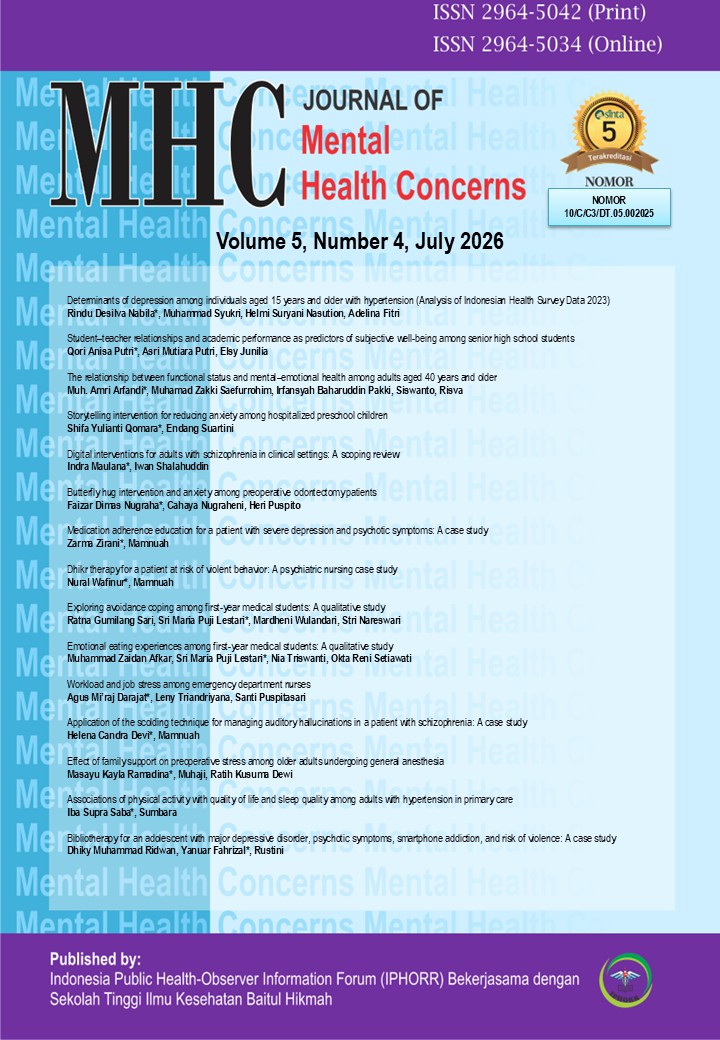
Bibliotherapy for an adolescent with major depressive disorder, psychotic symptoms, smartphone addiction, and risk of violence: A case study

DOI: https://doi.org/10.56922/mhc.v5i4.4053
Adolescents Bibliotherapy Major Depressive Disorder Risk of Violent Behaviour Smartphone Addiction
Abstract
Background: Major depressive disorder in adolescents is often accompanied by emotional and behavioural problems. Excessive smartphone use may further aggravate these conditions and contribute to behavioural disturbances, including an increased risk of violent behaviour.
Purpose: To describe the implementation of bibliotherapy as a non-pharmacological psychiatric nursing intervention for an adolescent with major depressive disorder, psychotic symptoms, a risk of violent behaviour, and high smartphone addiction.
Method: This descriptive case study was conducted in Lily 3 Ward of Soerojo Hospital. A 15-year-old adolescent received bibliotherapy as part of comprehensive psychiatric nursing care for seven consecutive days. Baseline emotional and behavioural functioning was assessed using the Strengths and Difficulties Questionnaire (SDQ), while smartphone addiction was evaluated using the Smartphone Addiction Scale (SAS).
Results: Baseline SDQ assessment showed normal emotional symptoms (score = 2) and hyperactivity (score = 4), abnormal conduct problems (score = 6) and prosocial behaviour (score = 3), as well as borderline peer problems (score = 4) and total difficulties (score = 16). The baseline SAS score was 104, indicating a high level of smartphone addiction before the nursing intervention.
Conclusion: The baseline findings demonstrated emotional and behavioural difficulties, particularly conduct problems, impaired prosocial behaviour, borderline overall difficulties, and high smartphone addiction in an adolescent with major depressive disorder. These findings support the implementation of bibliotherapy as part of comprehensive psychiatric nursing care to address the patient's emotional and behavioural needs.
Keywords: Adolescents; Bibliotherapy; Major Depressive Disorder; Risk of Violent Behaviour; Smartphone Addiction.
Downloads
References
Al Atsari, A. R., & Ichsan, I. (2025). Dinamika perkembangan remaja: Menelusuri jalan perkembangan diri, kemandirian, dan aspek psikososial. Jurnal Ilmiah Nusantara, 2(2), 220–229.
Al-Kandari, Y. Y., & Al-Sejari, M. M. (2021). Social isolation, social support and their relationship with smartphone addiction. Information, Communication & Society, 24(13), 1925-1943.
Andrade, A. L. M., Scatena, A., Martins, G. D. G., de Oliveira Pinheiro, B., da Silva, A. B., Enes, C. C., & Kim, D. J. (2020). Validation of smartphone addiction scale–Short version (SAS-SV) in Brazilian adolescents. Addictive Behaviors, 110, 106540.
Aryani, F. X., Basaria, D., & Pranawati, S. Y. (2020). Penerapan bibliotherapy untuk menurunkan tingkat perilaku agresi pada remaja di LPKA X. Jurnal Muara Ilmu Sosial, Humaniora, dan Seni, 4(1), 51–59.
Castillo-Eito, L., Armitage, C. J., Norman, P., Day, M. R., Dogru, O. C., & Rowe, R. (2020). How can adolescent aggression be reduced? A multi-level meta-analysis. Clinical Psychology Review, 78, 101853.
Diah, K. (2023). Hubungan intensitas penggunaan gadget dengan depresi, kecemasan dan stres pada siswa sekolah menengah atas negeri di Kota Metro (Doctoral dissertation, Universitas Lampung).
Faradianti, E. (2025). Dampak durasi screen time terhadap kualitas tidur pada anak sekolah dasar: Studi kasus di Gorontalo. Journal of Medical Health, 2(1), 1–11.
Fiqih, F. T., Wahyuningtyas, A., Aziz, A. A., & Setiowati, E. A. (2020). Efektivitas biblioterapi kelompok untuk menurunkan agresivitas siswa sekolah dasar. Jurnal Psikologi Ilmiah, 12(1), 93–102.
Girela-Serrano, B. M., Spiers, A. D., Ruotong, L., Gangadia, S., Toledano, M. B., & Di Simplicio, M. (2024). Impact of mobile phones and wireless devices use on children and adolescents' mental health: A systematic review. European Child & Adolescent Psychiatry, 33(6), 1621–1651.
Kamaruddin, I., Leuwol, F. S., Putra, R. P., Aina, M., Suwarma, D. M., & Zulfikhar, R. (2023). Dampak penggunaan gadget pada kesehatan mental dan motivasi belajar siswa di sekolah. Journal on Education, 6(1), 307–316.
Kurniawan, I. D. Y., Rustika, I. M., & Aryani, L. N. A. (2016). Uji validitas dan reliabilitas modifikasi Smartphone Addiction Scale versi Bahasa Indonesia. Medicina, 47(3), 1–9.
Liao, F., Liang, J., Zhang, M., Liang, W., Zhang, C., & Yun, X. (2025). Recent developments in bibliotherapy for adolescent depression. Frontiers in Psychiatry, 16, 1681462.
Lubis, F. M., Ainun, W. O. N., Munizu, M., & Fathurohman, A. (2023). Use of bibliotherapy as an effort to prevent negative student behavior. Jurnal Konseling Pendidikan Islam, 4(2), 279–286.
Méndez, M. L., Padron, I., Fumero, A., & Marrero, R. J. (2024). Effects of internet and smartphone addiction on cognitive control in adolescents and young adults: A systematic review of fMRI studies. Neuroscience & Biobehavioral Reviews, 159, 105572.
Nakshine, V. S., Thute, P., Khatib, M. N., & Sarkar, B. (2022). Increased screen time as a cause of declining physical, psychological health, and sleep patterns: a literary review. Cureus, 14(10).
Nasution, S. (2023). Bibliotherapy utilizing electronic publications to increase the self-confidence of teenagers victims of bullying. Mimbar Ilmu, 28(3), 539–548.
Natsir, L., Murdiana, S., & Nur, H. (2023). Bibliotherapy in reducing depression tendencies in college students. JIP (Jurnal Intervensi Psikologi), 15(1), 23–34.
Nuraenah, N., Widakdo, G., Naryati, N., Aisyah, A., Fadhillah, H., Adelia, A., & Adelia, M. (2023). Edukasi kesehatan mental (masalah psikososial) pada remaja. Jurnal Kreativitas Pengabdian Kepada Masyarakat (PKM), 6(10), 4307–4316.
Prajnaparamita, K. A. A., & Arfa, M. (2024). A systematic literature review: Biblioterapi sebagai upaya mengurangi kecanduan penggunaan gadget pada anak. Jurnal Ilmu Perpustakaan, 13(2), 78–93.
Prihatmono, I. G. (2025). Faktor-faktor yang mempengaruhi kejadian depresi pada remaja di Indonesia dengan pendekatan teori lingkungan. Journal Scientific of Mandalika (JSM), 6(3), 608–616.
Putri, F. S., Nazihah, Z., Ariningrum, D. P., Celesta, S., & Herbawani, C. K. (2022). Depresi remaja di Indonesia: Penyebab dan dampaknya. Jurnal Kesehatan Poltekkes Kemenkes RI Pangkalpinang, 10(2), 99-108.
Ryanti, D. E., & Damaiyanti, M. (2021). Hubungan frustrasi dengan perilaku kekerasan pada remaja: Literature review. Borneo Studies and Research, 3(1), 352–361.
Salem, G. M. M., Hashimi, W., & El-Ashry, A. M. (2025). Reflective mindfulness and emotional regulation training to enhance nursing students’ self-awareness, understanding, and regulation: a mixed method randomized controlled trial. BMC nursing, 24(1), 478.
Sundara, A. K., Larasati, B., Meli, D. S., Wibowo, D. M., Utami, F. N., Maulina, S., & Gunarti, N. S. (2022). Gangguan kecemasan. Jurnal Buana Farma: Jurnal Ilmiah Farmasi, 2(2), 78-84.
Syahputra, I. R. B. (2025). Hubungan kecanduan media sosial dengan tingkat depresi, cemas, dan stres pada mahasiswa keperawatan di Malang (Doctoral dissertation, Universitas Muhammadiyah Malang).
Thapar, A., Eyre, O., Patel, V., & Brent, D. (2022). Depression in young people. The Lancet, 400(10352), 617–631.
Wati, N. M. D. A., Susila, I. M. D. P., & Purwaningsih, N. K. (2021). Pengaruh biblioterapi terhadap penurunan kecemasan anak yang menjalani hospitalisasi di RS Bhayangkara Denpasar. Journal of Advanced Nursing and Health Sciences, 2(2), 59–64.
Wiguna, T., Manengkei, P. S. K., Pamela, C., Rheza, A. M., & Hapsari, W. A. (2016). Masalah emosi dan perilaku pada anak dan remaja di poliklinik jiwa anak dan remaja RSUPN dr. Ciptomangunkusumo (RSCM), Jakarta. Sari Pediatri, 12(4), 270-7.
Wu, T. J., Sheih, C. S. M., Jou, S. T., Lee, C. Y., Yu, T. Y., Liu, C. Y., & Chen, C. W. (2025). Effects of bibliotherapy on emotional distress, coping strategies, and resilience in adolescents with cancer: A pilot randomized controlled trial. European Journal of Oncology Nursing, 76, 102900.
Zuhri, I., & Rohmah, F. A. (2023). Cognitive behavior therapy pada individu yang mengalami depresi. Psikostudia: Jurnal Psikologi, 12(2), 184–191.
Downloads
Published
Issue
Section
License
Copyright (c) 2026 JOURNAL OF Mental Health Concerns

This work is licensed under a Creative Commons Attribution-NonCommercial-NoDerivatives 4.0 International License.