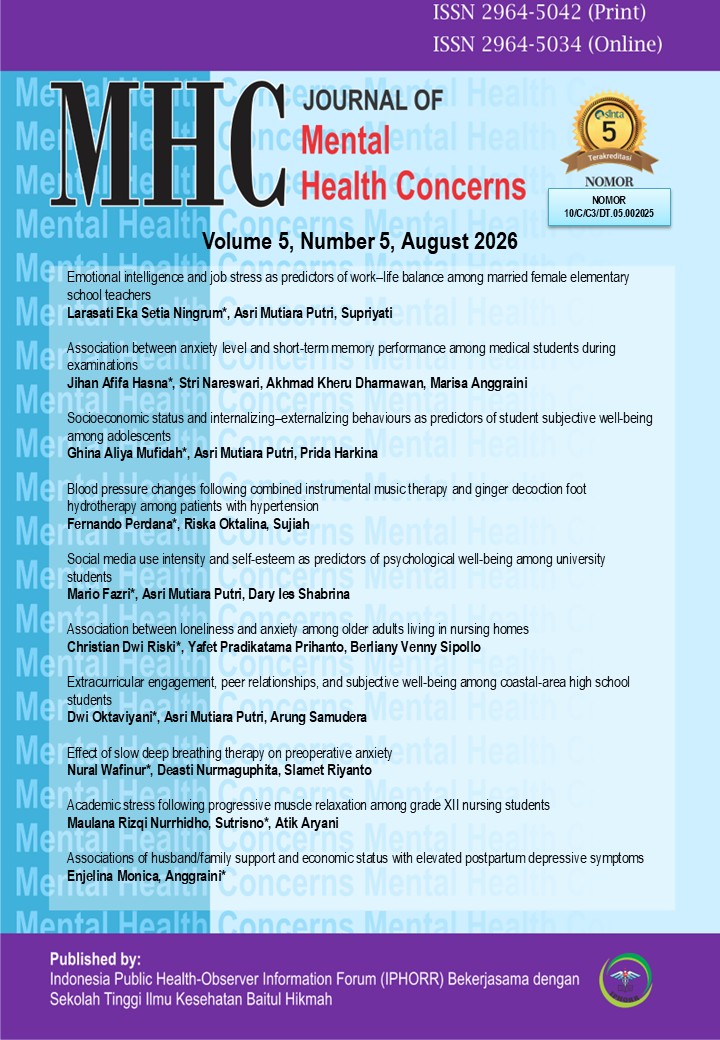
Emotional intelligence and job stress as predictors of work–life balance among married female elementary school teachers

DOI: https://doi.org/10.56922/mhc.v5i5.3569
Emotional Intelligence Job Stress Married Female Teachers Work–Life Balance
Abstract
Background: The increasing participation of women in the workforce has led to multiple-role demands, particularly among married female teachers, which may affect their work–life balance. Emotional intelligence and job stress are considered important factors influencing work–life balance.
Purpose: To examine whether emotional intelligence and job stress predict work–life balance among married female elementary school teachers.
Method: This quantitative correlational study involved 106 married female elementary school teachers recruited through convenience sampling. Participants were recruited from elementary schools in Kemiling District, Bandar Lampung, Indonesia. Data were collected using the Work–Life Balance Scale, Emotional Intelligence Scale, and Job Stress Scale. Data were analyzed using multiple regression analysis.
Results: The findings indicated that emotional intelligence and job stress significantly contributed to work–life balance among married female teachers. Emotional intelligence showed a positive contribution, whereas job stress demonstrated a negative contribution to work–life balance.
Conclusion: Higher emotional intelligence and lower job stress were associated with better work–life balance. School-based support and stress-management initiatives may help teachers manage competing work and family responsibilities.
Keywords: Emotional Intelligence; Job Stress; Married Female Teachers; Work–Life Balance.
Downloads
References
Abdillah, M. R., & Rahmat, A. (2017). Kecerdasan emosional dan dampaknya terhadap stres kerja dan kinerja karyawan. JEBI (Jurnal Ekonomi dan Bisnis Islam), 2(1), 43–57.
Annisa, N. N., Wardhani, D. P., & Amallia, F. (2022). Quality work of life, job satisfaction dan social support terhadap employee engagement dosen perguruan tinggi swasta di Surakarta. Benefit: Jurnal Manajemen dan Bisnis, 7(1), 41–52.
Ardi, V. T. P., Astuti, E. S., & Sulistyo, C. W. (2017). Pengaruh self-efficacy terhadap employee engagement dan kinerja karyawan. Jurnal Administrasi Bisnis, 52(1), 163–172.
Arlianto, S., Qomariah, N., & Hermawan, H. (2026). Effect of work overload, work–life balance, and job conflict on employee performance with emotional intelligence as a moderating variable. Ekombis Review: Jurnal Ilmiah Ekonomi dan Bisnis, 14(1), 879–888.
Bello, Z., & Tanko, G. I. (2020). Review of work-life balance theories. GATR Global Journal of Business and Social Science Review, 8(4), 217–227.
Du, D., Derks, D., & Bakker, A. B. (2018). Daily spillover from family to work: A test of the work–home resources model. Journal of Occupational Health Psychology, 23(2), 237–247
Gynastiar, M. G., & Mangundjaya, W. L. (2025). Work–life balance sebagai prediktor stres kerja di kalangan pegawai Dinas X Pemda Kabupaten Bekasi. Jurnal Komunikasi dan Ilmu Sosial, 3(3), 90–95.
Hakim, G. R. U., & Rizky, D. K. (2021). Hubungan resiliensi dengan stres kerja karyawan bagian layanan pelanggan PT X area Jawa Timur di masa pandemik COVID-19. Seminar Nasional Psikologi dan Ilmu Humaniora (SENAPIH), 1(1), 201–212.
Hasby, M., Hendriani, S., & Indarti, S. (2017). Pengaruh konflik kerja, beban kerja dan komunikasi terhadap stres kerja perawat bagian rawat inap (pada RSUD Petala Bumi Pekanbaru) (Doctoral dissertation, Riau University).
Irmawati, I., & Kn, A. S. W. (2017). Pengaruh quality of work life, self-determination, dan job performance terhadap work engagement karyawan. Jurnal Manajemen Dayasaing, 19(1), 27–36.
Lesener, T., Gusy, B., & Wolter, C. (2019). The job demands–resources model: A meta-analytic review of longitudinal studies. Work & Stress, 33(1), 76–103.
Naz, S., Ahmad, S., & Batool, A. (2021). Emotional intelligence and work–life balance: A study of working women teachers in public sector universities. Humanities & Social Sciences Reviews, 9(2), 141–149.
Nurhabiba, M. (2020). Social support terhadap work–life balance pada karyawan. Cognicia, 8(2), 277–295.
Pangestu, D. A., & Ardiana, I. D. K. R. (2024). Pengaruh self-efficacy, self-esteem, dan employee engagement terhadap kinerja karyawan PT Usaha Utama Bersaudara Surabaya. Manajemen Kreatif Jurnal, 2(3), 154–172.
Paraswati, A. D., Amelia, T., & Pujianto, W. E. (2024). Pengaruh work life balance dan emotional intelligence sebagai komponen penting untuk mencapai quality of work–life dan kinerja individu. Jurnal Arastirma, 4(1), 1–13.
Putri, A. M., Suroso, S., & Rista, K. (2024). Stres kerja, emotional intelligence, dan work–life balance: Studi pada karyawan. SUKMA: Jurnal Penelitian Psikologi, 5(1), 85–94.
Sari, R. M. (2024). Pengaruh work–life balance dan stres kerja terhadap kinerja karyawan PT Petrokopindo Cipta Selaras (Doctoral dissertation, UPN Veteran Jawa Timur).
Sofiah, D., & Kurniawan, G. (2019). Hubungan self-efficacy dengan employee work engagement pada karyawan. Fenomena, 28(1), 19–30.
Tanessa, V. I., & Halida, A. N. (2025). Hubungan antara kecerdasan emosional dengan work–life balance pada karyawan di PT. X. Character: Jurnal Penelitian Psikologi, 12(2), 714–729.
Yurista, D., Bakar, A., & Mirza, M. (2017). Hubungan antara kecerdasan emosi dengan stres kerja pada perawat. Jurnal Psikogenesis, 5(1), 43–54.
Zakaria, M., Ismail, A., Hendratni, T. W., Putrianti, F. G., Soeprapto, A., & Lubis, F. M. (2025). Analisis pengaruh self-leadership, workplace well-being, dan pengembangan karir terhadap employee engagement pada industri jasa. Jurnal Lentera Bisnis, 14(2), 1953–1962.
Downloads
Published
Issue
Section
License
Copyright (c) 2026 JOURNAL OF Mental Health Concerns

This work is licensed under a Creative Commons Attribution-NonCommercial-NoDerivatives 4.0 International License.