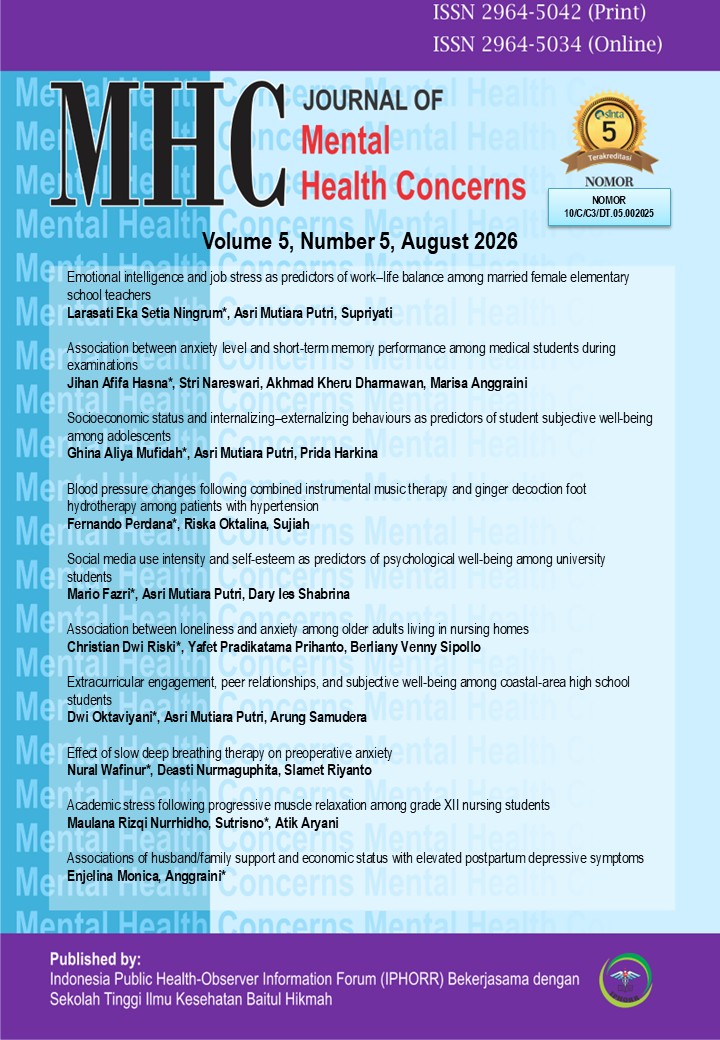
Extracurricular engagement, peer relationships, and subjective well-being among coastal-area high school students

DOI: https://doi.org/10.56922/mhc.v5i5.3553
Coastal Students Extracurricular Engagement Peer Relationships Student Subjective Well-Being
Abstract
Background: The importance of Student Subjective Well-Being (SSWB) is highly critical in supporting students' mental health and academic success. Engagement in extracurricular activities and peer relationships are strongly presumed to be significant factors influencing the level of students' SSWB, particularly for those living in coastal areas.
Purpose: To determine the effects of extracurricular engagement and peer relationships on student subjective well-being among high school students in coastal areas.
Method: This quantitative study employed a descriptive-correlational design. The participants were 148 students from a senior high school located in the coastal area of Pesawaran Regency, Lampung Province, Indonesia. Participants were recruited using quota sampling. Data were collected using Likert-scale questionnaires and analyzed using multiple linear regression.
Results: Based on the statistical analysis, multiple linear regression showed that extracurricular engagement and peer relationships were significantly associated with student subjective well-being. Peer relationships showed a stronger association and a greater effective contribution than extracurricular engagement.
Conclusion: Schools should promote supportive social environments and positive peer interactions to improve students’ subjective well-being, particularly in coastal communities.
Keywords: Coastal Students; Extracurricular Engagement; Peer Relationships; Student Subjective Well-Being.
Downloads
References
Allen, K. A., Furlong, M. J., Vella-Brodrick, D., & Suldo, S. (Eds.). (2022). Handbook of positive psychology in schools: Supporting process and practice. Routledge.
Arslan, G., & Coşkun, M. (2020). Student subjective wellbeing, school functioning, and psychological adjustment in high school adolescents: A latent variable analysis. Journal of Positive School Psychology, 4(2), 153–164.
Aydoğdu, F., & Kelpšiene, M. (2021). Uses of augmented reality in preschool education. International Technology and Education Journal, 5(1), 11–20.
Clarke, T., McLellan, R., & Harold, G. (2025). Beyond life satisfaction: Wellbeing correlates of adolescents’ academic attainment. School Psychology Review, 54(1), 31–50.
Diener, E., Heintzelman, S. J., Kushlev, K., Tay, L., Wirtz, D., Lutes, L. D., & Oishi, S. (2017). Findings all psychologists should know from the new science on subjective well-being. Canadian Psychology/Psychologie Canadienne, 58(2), 87.
Diener, E., Oishi, S., & Tay, L. (2018). Advances in subjective well-being research. Nature Human Behaviour, 2(4), 253–260.
Huang, Y., Wu, X., Tamim, M., Jin, X., Ma, L., & Xu, J. (2025). How does family economic background shape adolescents’ present- and future-oriented well-being? Roles of perceived discrimination and grit. BMC Psychology, 13(1), 628.
Juliyanti, J. (2025). Relationship between peer relationships and mental health among high school adolescents. Open Access Health Scientific Journal, 6(1), 48–53.
Kabir, S., Newnham, E. A., Dewan, A., Islam, M. M., & Hamamura, T. (2024). Sea-level rise and mental health among coastal communities: A quantitative survey and conditional process analysis. SSM - Population Health, 25, 101640.
Mursandi, R., Putri, A. M., & Sandayanti, V. (2022). Peran lingkungan belajar dan self efficacy terhadap college student subjective well-being. Jurnal Psikologi Malahayati, 4(2).
Oranga, J., & Matere, A. (2025). Quantitative research: Types, advantages, generalizability, and limitations. Open Access Library Journal, 12, 1–9.
Österholm, L., Widlund, A., & Korhonen, J. (2026). Student engagement and burnout profiles among elementary school students–stability and relations to academic performance. European Journal of Developmental Psychology, 23(3), 324–342.
Phan, H. P. (2016). Situating attributes of academic well-being within a motivational framework: A longitudinal investigation. Journal of Education Research, 10(1).
Shek, D. T. L., Leung, K. H., Dou, D., & Zhu, X. (2022). Impact of family functioning on adolescent materialism and egocentrism in mainland China: Positive youth development attributes as a mediator. International Journal of Environmental Research and Public Health, 19(17), 11038.
Ullsperger, J. M., & Nikolas, M. A. (2017). A meta-analytic review of the association between pubertal timing and psychopathology in adolescence: Are there sex differences in risk? Psychological Bulletin, 143(9), 903.
Umar, J., & Nisa, Y. F. (2020). Uji validitas konstruk dengan CFA dan pelaporannya.
Villemaire-Krajden, R., & Barker, E. (2024). Curbing the campus mental health crisis: The role of extracurricular activity participation. Journal of Youth Development, 19(2), 2.
Wangi, S., Putri, A. M., & Arisandi, S. (2025). The role of academic achievement and parental involvement in improving student subjective well-being. Philanthropy: Journal of Psychology, 9(2), 152–168.
Wardoyo, T., Awalya, A., & Mulawarman, M. (2021). Contribution of self-efficacy and self-esteem to subjective well-being. Jurnal Bimbingan Konseling, 10(1), 22–28.
Widlund, A. (2021). Development of academic well-being during secondary education: Relations to performance, motivational beliefs, and aspirations.
Downloads
Published
Issue
Section
License
Copyright (c) 2026 JOURNAL OF Mental Health Concerns

This work is licensed under a Creative Commons Attribution-NonCommercial-NoDerivatives 4.0 International License.