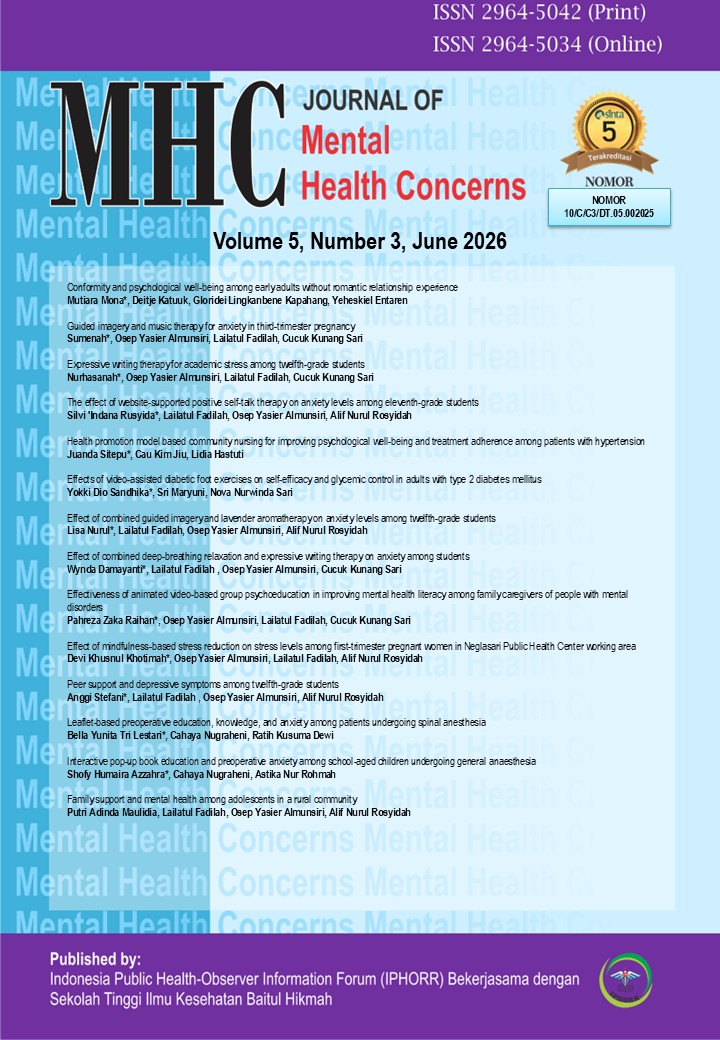
Peer support and depressive symptoms among twelfth-grade students

DOI: https://doi.org/10.56922/mhc.v5i3.3457
Adolescents Depressive Symptoms Mental Health Peer Support
Abstract
Background: Depression is one of the most prevalent mental health problems among adolescents and may negatively affect academic achievement, interpersonal relationships, and overall quality of life. Peer support is considered an important protective factor that can help adolescents cope with stress and emotional challenges during their developmental period.
Purpose: To determine the relationship between peer support and depressive symptoms among twelfth-grade adolescents.
Method: A quantitative correlational design with a cross-sectional approach. A total of 82 students were selected using a total sampling technique. Data were collected using peer support and depressive symptom questionnaires. Data were analysed using descriptive statistics and Chi-Square tests with a significance level of 0.05.
Results: Of the 82 respondents, 53.7% perceived supportive peer support, whereas 46.3% reported less supportive peer support. Most respondents experienced mild depressive symptoms (61.0%), followed by no depressive symptoms (25.6%) and moderate depressive symptoms (13.4%). Chi-Square analysis revealed no significant relationship between overall peer support and depressive symptoms (p = 0.295). Among the dimensions of peer support, only appraisal support was significantly associated with depressive symptoms (p = 0.011). Emotional support (p = 0.193), instrumental support (p = 0.239), informational support (p = 0.566), and companionship support (p = 0.143) were not significantly associated with depressive symptoms.
Conclusion: Overall peer support was not significantly associated with depressive symptoms among twelfth-grade adolescents. However, appraisal support showed a significant association with depressive symptoms, highlighting its potential role in promoting adolescent mental health.
Keywords: Adolescents; Depressive Symptoms; Mental Health; Peer Support.
Downloads
References
Al-Qudah, Y., & Baioumy, N. (2018). The relationship between social media and the level of ambition, depressive symptoms and anxiety among secondary school students in Irbid. International Journal of Academic Research in Business and Social Sciences, 8(11).
Cao, P., Li, Y., Yang, L., Guo, L., Hua, J., Zhang, S., & An, B. (2025). Evidence for various interventions to reduce depressive symptoms for children and adolescents: protocol of a global evidence and gap map. Systematic Reviews, 14(1), 162.
Cai, H., Niu, Y., Gao, X., Liu, R., Liu, Z., Guo, X., & Luo, L. (2025). Dynamic associations between Self-Efficacy and depressive symptoms during the transition to adolescence: A 3-year longitudinal study. Journal of Youth and Adolescence, 54(8), 2077-2093.
Crandall, A., Powell, E. A., Bradford, G. C., Magnusson, B. M., Hanson, C. L., Barnes, M. D., & Bean, R. A. (2020). Maslow’s hierarchy of needs as a framework for understanding adolescent depressive symptoms over time. Journal of Child and Family Studies, 29(2), 273-281.
Darling-Hammond, S., & Le, C. (2025). A School Mental Health Provider Like Me: Links Between Peer Racial Harassment, Depressive Symptoms, and Race-Matched School Counselors and Psychologists. International Journal of Environmental Research and Public Health, 22(4), 553.
Delawalla, M. L., Rhew, I. C., Jenness, J. L., McCauley, E. A., Lyon, A. R., & Vander Stoep, A. (2025). Associations between Perceived Teacher Support, Stressful Life Events, and Depressive Symptoms in Early Adolescence. Journal of Child and Family Studies, 34(7), 1774-1785.
Doumas, D. M., Midgett, A., & Peck, M. (2023). The association between internalizing symptoms and witnessing school bullying and defending behavior: an analysis of gender differences among elementary and middle school students. Children, 10(7), 1199.
Faridah, N., & Lestari, N. P. F. K. (2025). The Impact of Social Media on Sleep Quality and Adolescent Psychological Condition in the Digital Era. International Journal of Multidisciplinary Research and Creative Innovation Ideas, 1(2), 160-171.
Friedman, L. D., & Jones, T. (Eds.). (2022). Routledge handbook of health and media. Routledge, Taylor & Francis Group.
Gunnarsdóttir, H. H. (2024). Effects of parental and peer support on self-esteem in adolescents (Doctoral dissertation).
Hesapcioglu, S. T., & Yesilova, H. (2020). Internet addiction prevalence in youths and its relation with depressive symptoms, self-esteem, and bullying. Alpha Psychiatry, 21(5), 483-490.
Li, J., & Yang, C. (2026). Sex-Specific Trajectories of Depressive Symptoms among Multicultural Adolescents: Intrapersonal and Interpersonal Protective Factors. Research on Child and Adolescent Psychopathology, 54(2), 43.
Nashon, R., Metta, E., & Chande-Mallya, R. (2025). Development Of Adolescents as the Natural Magnet and Sources of Conflicts Between Adolescent Students and Teachers in Secondary Schools in Arumeru, Arusha, Tanzania. Journal of Humanities and Social Sciences Research Practice, 1(1).
Pushap, A. C., Sudershan, S., Bhagat, S., Sachdeva, P., Younis, M., Sudershan, A., & Kumar, P. (2025). Depression and its major risk factors in India: A narrative review. Advanced Neurology, 4(3), 29-59.
Sarhangi, N., Rostami, M., Abbasirad, R., Fasihi, M., & Ahmadboukani, S. (2023). Cyber victimization and suicidal behavior in high school students: the mediating role of psychological problems and perceived social support. Psychology in the Schools, 60(7), 2395-2408.
Surinto, E., Saifudin, M., & Rokhman, A. (2025). The Relationship Between Borderline Personality Disorder And Peer Support With Adolescent Anxiety. Jurnal Keperawatan Malang, 10(2), 212-222.
Wang, M. T., Chow, A., & Amemiya, J. (2017). Who wants to play? Sport motivation trajectories, sport participation, and the development of depressive symptoms. Journal of youth and adolescence, 46(9), 1982-1998.
World Health Organization. (2024). Report of the eighth meeting of the WHO Strategic and Technical Advisory Group of Experts for Maternal, Newborn, Child and Adolescent Health and Nutrition, 14-16 November 2023. World Health Organization.
Ye, Y., Zhang, Z., Tao, Z., Liping, C., Wang, Y., Chen, H., & Zhou, J. (2025). Academic pressure and psychological imbalance in high school students: predictors of depression via polynomial regression and response surface analysis. Psychology Research and Behavior Management, 15-23.
Zapolski, T. C., Rowe, A. T., Fisher, S., Hensel, D. J., & Barnes-Najor, J. (2018). Peer victimization and substance use: Understanding the indirect effect of depressive symptomatology across gender. Addictive Behaviors, 84, 160-166.
Downloads
Published
Issue
Section
License
Copyright (c) 2026 JOURNAL OF Mental Health Concerns

This work is licensed under a Creative Commons Attribution-NonCommercial-NoDerivatives 4.0 International License.