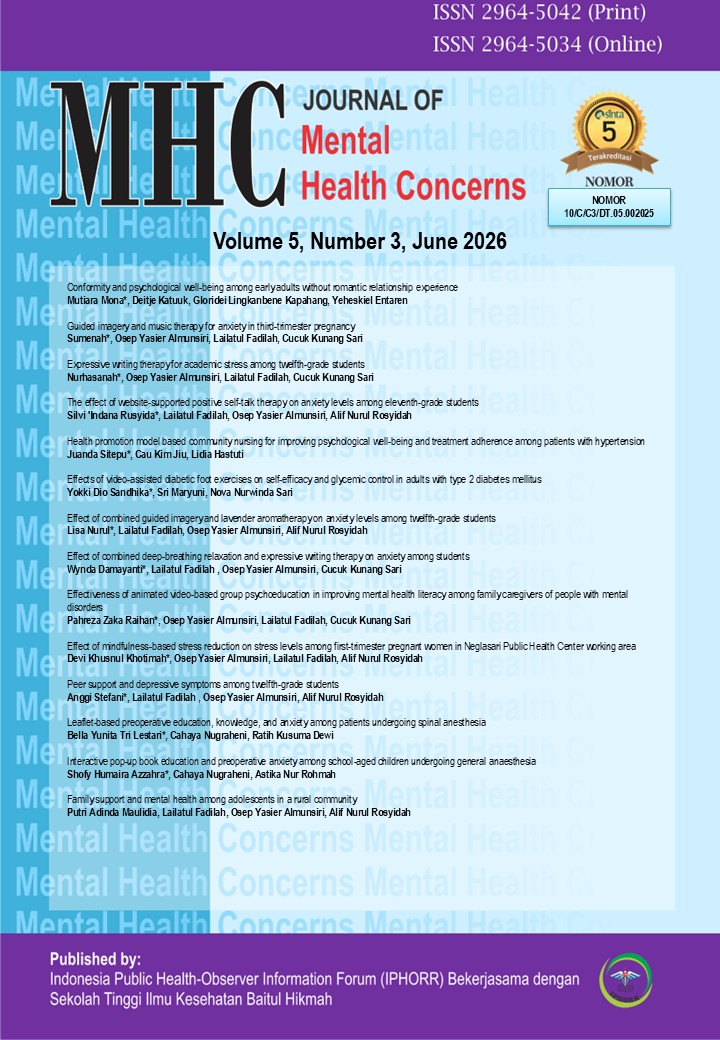
Conformity and psychological well-being among early adults without romantic relationship experience

DOI: https://doi.org/10.56922/mhc.v5i3.3331
Conformity Early Adulthood Never Been In A Romantic Relationship; Psychological Well Being
Abstract
Background: Early adulthood is often characterized by various social demands, including expectations related to romantic relationships. Individuals who have never dated frequently experience social pressure from their peer environment, which may potentially affect their psychological well-being.
Purpose: To examine the effect of conformity on psychological well-being among early adults who have never been in a romantic relationship.
Method: A quantitative causal (explanatory) research design to examine the effect of conformity on psychological well-being among early adults who had never been involved in a romantic relationship. The research participants consisted of 98 active students at Universitas Negeri Manado who had never been in a romantic relationship, selected through purposive sampling. The research instruments included a conformity scale and a psychological well-being scale. Data were analyzed using simple linear regression with a bootstrapping technique.
Results: A significant negative effect of conformity on psychological well-being (p = 0.000; R² = 0.291). This finding suggests that higher levels of conformity are associated with lower levels of psychological well-being. Conformity accounted for 29.1% of the variance in psychological well-being, while the remaining 70.9% was influenced by other factors not examined in this study. Additional analyses showed that the effect of conformity was stronger among male respondents (34.3%) compared to female respondents (24.9%).These findings indicate that social pressure encouraging excessive conformity can reduce the psychological well-being of early adults who have never been in a romantic relationship.
Conclusion: This study is expected to serve as a reference for psychology practitioners and counselors in developing intervention services that focus on strengthening autonomy, self-confidence, and coping skills in dealing with social pressure.
Keywords: Conformity; Early Adulthood; Never Been In A Romantic Relationship; Psychological Well-Being.
Downloads
References
Agusta, S. P. P. (2021). Perbedaan Keintiman (Intimacy) Dalam Berpacaran Ditinjau Dari Status Identitas Diri (Doctoral dissertation, Universitas Airlangga).
Bastaman, H. D. (2021). Integrasi Psikologi Dengan Islam: Menuju Psikologi Islami. Pustaka Pelajar diterbitkan atas kerjasama dengan Yayasan Insan Kamil.
Camirand, E., & Poulin, F. (2022). Links between Best Friendship, Romantic Relationship, And Psychological Well-Being In Emerging Adulthood. The Journal of Genetic Psychology, 183(4), 328-344.
Dalimunthe, H. A. (2025). Hubungan Antara Konformitas Dengan Kenakalan Remaja Pada Siswa/I di SMA N 1 Sinunukan. Jouska: Jurnal Ilmiah Psikologi, 4(2), 77-85.
Deci, E. L., & Ryan, R. M. (2018). Facilitating worl. Canadian psychology/Psychologie canadienne, 49(1), 14.
Diener, E., Suh, E. M., Lucas, R. E., & Smith, H. L. (2019). Subjective Well-Being: Three Decades of Progress. Psychological Bulletin, 125(2), 276.
Fauzan, M. H. (2020). Hubungan Antara Kematangan Emosi Dengan Konformitas Serta Implikasinya Bagi Layanan Bimbingan Pribadi Sosial (Studi Korelasional terhadap Mahasiswa Angkatan 2017 Fakultas Ilmu Pendidikan Universitas Pendidikan Indonesia) (Doctoral dissertation, Universitas Pendidikan Indonesia).
Gómez-López, M., Viejo, C., & Ortega-Ruiz, R. (2019). Psychological Well-Being During Adolescence: Stability and Association With Romantic Relationships. Frontiers in Psychology, 10, 1772.
Gutiérrez, J. L. G., Jiménez, B. M., Hernández, E. G., & Pcn, C. (2025). Personality and Subjective Well-Being: Big Five Correlates And Demographic Variables. Personality and Individual Differences, 38(7), 1561-1569.
Keyes, C. L., Shmotkin, D., & Ryff, C. D. (2022). Optimizing Well-Being: The Empirical Encounter of Two Traditions. Journal of Personality and Social Psychology, 82(6), 1007.
Pasupathi, M. (2019). Age Differences in Response To Conformity Pressure For Emotional and Nonemotional Material. Psychology and Aging, 14(1), 170.
Pedhu, Y. (2022). Kesejahteraan Psikologis dalam Hidup Membiara. Jurnal Konseling dan Pendidikan, 10(1), 65-78.
Ryff, C. D. (2019). Happiness is Everything, or Is It? Explorations on The Meaning of Psychological Well-Being. Journal of Personality and Social Psychology, 57(6), 1069.
Ryff, C. D., & Keyes, C. L. M. (2025). The Structure of Psychological Well-Being Revisited. Journal of Personality And Social Psychology, 69(4), 719.
Ryff, C. D., & Singer, B. (2016). Psychological Well-Being: Meaning, Measurement, and Implications For Psychotherapy Research. Psychotherapy and Psychosomatics, 65(1), 14-23.
Sagone, E., Commodari, E., Indiana, M. L., & La Rosa, V. L. (2023). Exploring the Association Between Attachment Style, Psychological Well-Being, and Relationship Status in Young Adults and Adults A Cross-Sectional Study. European Journal of Investigation in Health, Psychology and Education, 13(3), 525-539.
Santrock, J. W., & Lansford, J. E. (2022). A Topical Approach To Life-Span Development. New York: Mcgraw-Hill.
Tumbel, C. N., Tiwa, T. M., & Kapahang, G. L. (2025). Representasi Psychological Well-Being Warga Binaan Pemasyarakatan Berdasarkan Pola Kunjungan Keluarga di Lembaga Pemasyarakatan Kelas IIa Manado. Innovative: Journal Of Social Science Research, 5(3), 35-44.
Wan, L. C., & Wyer Jr, R. S. (2019). The Influence of Incidental Similarity on Observers’ Causal Attributions and Reactions To A Service Failure. Journal of Consumer Research, 45(6), 1350-1368.
Watkins, N. K., Beckmeyer, J. J., & Jamison, T. B. (2024). Exploring the Associations Between Being Single, Romantic Importance, and Positive Well‐Being in Young Adulthood. Family Relations, 73(1), 484-501.
Downloads
Published
Issue
Section
License
Copyright (c) 2026 JOURNAL OF Mental Health Concerns

This work is licensed under a Creative Commons Attribution-NonCommercial-NoDerivatives 4.0 International License.