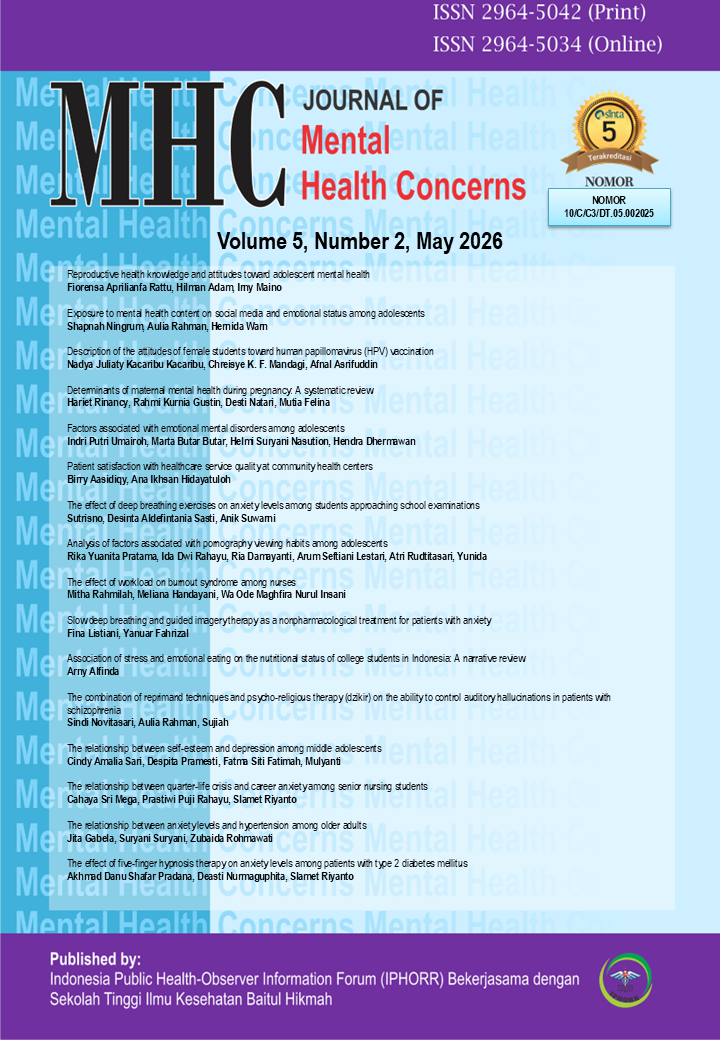
Reproductive health knowledge and attitudes toward adolescent mental health

DOI: https://doi.org/10.56922/mhc.v5i2.2966
Attitude Adolescents High School Students Knowledge Reproductive Health
Abstract
Background: Reproductive health is a state of complete physical, mental, and social well-being related to the reproductive system, its functions, and processes, not merely the absence of disease or disability. Lack of knowledge about reproductive health among adolescents can lead to various problems such as unintended pregnancy, abortion, early marriage, sexually transmitted infections (STIs), and HIV/AIDS. Therefore, adequate knowledge and positive attitudes toward reproductive health are essential to prevent these risks, especially among high school students.
Purpose: To describe the level of knowledge and attitudes toward reproductive health among adolescents.
Method: A quantitative design with an analytic survey approach. The sampling technique used was non-probability sampling with a purposive sampling method. The population consisted of 282 students, with a sample of 247 respondents. Data were collected using a questionnaire and analyzed using Microsoft Excel and the Statistical Programmer for Social Science (SPSS).
Results: The majority of respondents had good knowledge, with 214 students (86.6%) categorized as having a high level of knowledge. In terms of attitude, most respondents also demonstrated positive attitudes toward reproductive health, with 162 students (65.6%).
Conclusion: Most adolescents have good knowledge and positive attitudes regarding reproductive health. However, continuous education is still needed to maintain and further improve awareness and positive attitudes toward reproductive health.
Keywords: Attitude; Adolescents; High School Students; Knowledge; Reproductive Health.
Downloads
References
Adjie, J. M., Kurniawan, A. P., & Surya, R. (2022). Knowledge, attitude, and practice towards reproductive health issue of adolescents in rural area, Indonesia: A cross-sectional study. The Open Public Health Journal, 15(1).
AlQuaiz, A. M., Kazi, A., & Al Muneef, M. (2023). Determinants of sexual health knowledge in adolescent girls in schools of Riyadh-Saudi Arabia: a cross sectional study. BMC women's health, 13(1), 19.
Bakhtiari, A., Pasha, H., Kashefi, F., Nasiri-Amiri, F., & Bakouei, F. (2023). Factors affecting students’ attitudes towards reproductive health in the north of Iran: Designing an educational program. BMC Public Health, 23(1), 1557.
Dewi, M. U. K. (2023). Buku ajar kesehatan reproduksi dan keluarga berencana untuk mahasiswa bidan. Jakarta: Trans Info Medika.
Gaferi, S. M., Al-Harbi, M. F., Yakout, S. M., & Soliman, A. T. (2018). Knowledge, attitude and practice related to reproductive health among female adolescents. Journal of Nursing Education and Practice, 8(8), 53-65.
Hall, K. S., Morhe, E., Manu, A., Harris, L. H., Ela, E., Loll, D., & Dalton, V. K. (2018). Factors associated with sexual and reproductive health stigma among adolescent girls in Ghana. PloS one, 13(4), e0195163.
Harnani, Y., Marlina, H., & Kursani, E. (2025). Teori kesehatan reproduksi. Deepublish.
Hurlock, E. B. (2017). Psikologi perkembangan: suatu pendekatan sepanjang rentang kehidupan.
Inayat Ali, A., Azam, I., Tikmani, S. S., & Saleem, S. (2025). Sexual and reproductive health knowledge, attitudes and practices among adolescents in rural Thatta, Pakistan: a cross-sectional study. BMJ open, 15(4), e096404.
Kashefi, F., Bakhtiari, A., Pasha, H., Amiri, F. N., & Bakouei, F. (2021). Student attitudes about reproductive health in public universities: a cross-sectional study. International quarterly of community health education, 41(2), 133-142.
Kyilleh, J. M., Tabong, P. T. N., & Konlaan, B. B. (2018). Adolescents’ reproductive health knowledge, choices and factors affecting reproductive health choices: a qualitative study in the West Gonja District in Northern region, Ghana. BMC international health and human rights, 18(1), 6.
Mbadu Muanda, F., Gahungu, N. P., Wood, F., & Bertrand, J. T. (2018). Attitudes toward sexual and reproductive health among adolescents and young people in urban and rural DR Congo. Reproductive health, 15(1), 74.
Putri, A., & bin Sansuwito, T. (2025). Determining the correlation between adolescent attitudes and practices in sexual and reproductive health. International Journal of Health Literacy and Science, 3(1), 40-48.
Rahmawati, D., & Agustin, L. (2020). Cegah stunting dengan stimulasi psikososial dan keragaman pangan. AE Publishing.
Rahmi, J., Romlah, S. N., Darmayanti, D., & Arimurti, I. S. (2020). Pentingnya Mengenali Kesehatan Reproduksi Bagi Remaja. JAM: Jurnal Abdi Masyarakat, 1(1).
Roza, S. D., & Yolanda, S., (2024). Kesehatan Reproduksi: Perspektif Klinis dan Sosial. Kaizen Media Publishing.
Solehati, T., Pramukti, I., Rahmat, A., & Kosasih, C. E. (2022). Determinants of adolescent reproductive health in West Java Indonesia: A cross-sectional study. International Journal of Environmental Research and Public Health, 19(19), 11927.
Tegegn, A., Yazachew, M., & Gelaw, Y. (2018). Reproductive health knowledge and attitude among adolescents: a community based study in Jimma Town, Southwest Ethiopia. The Ethiopian Journal of Health Development, 22(3).
Wright, S. M., Gabb, R. G., & Ryan, M. M. (2021). Reproductive health: knowledge, attitudes and needs of adolescents. Medical journal of Australia, 155(5), 325-328.
Zakaria, M., Karim, F., Mazumder, S., Cheng, F., & Xu, J. (2020). Knowledge on, attitude towards, and practice of sexual and reproductive health among older adolescent girls in Bangladesh: an institution-based cross-sectional study. International Journal of Environmental Research and Public Health, 17(21), 7720.
Downloads
Published
Issue
Section
License
Copyright (c) 2026 JOURNAL OF Mental Health Concerns

This work is licensed under a Creative Commons Attribution-NonCommercial-NoDerivatives 4.0 International License.