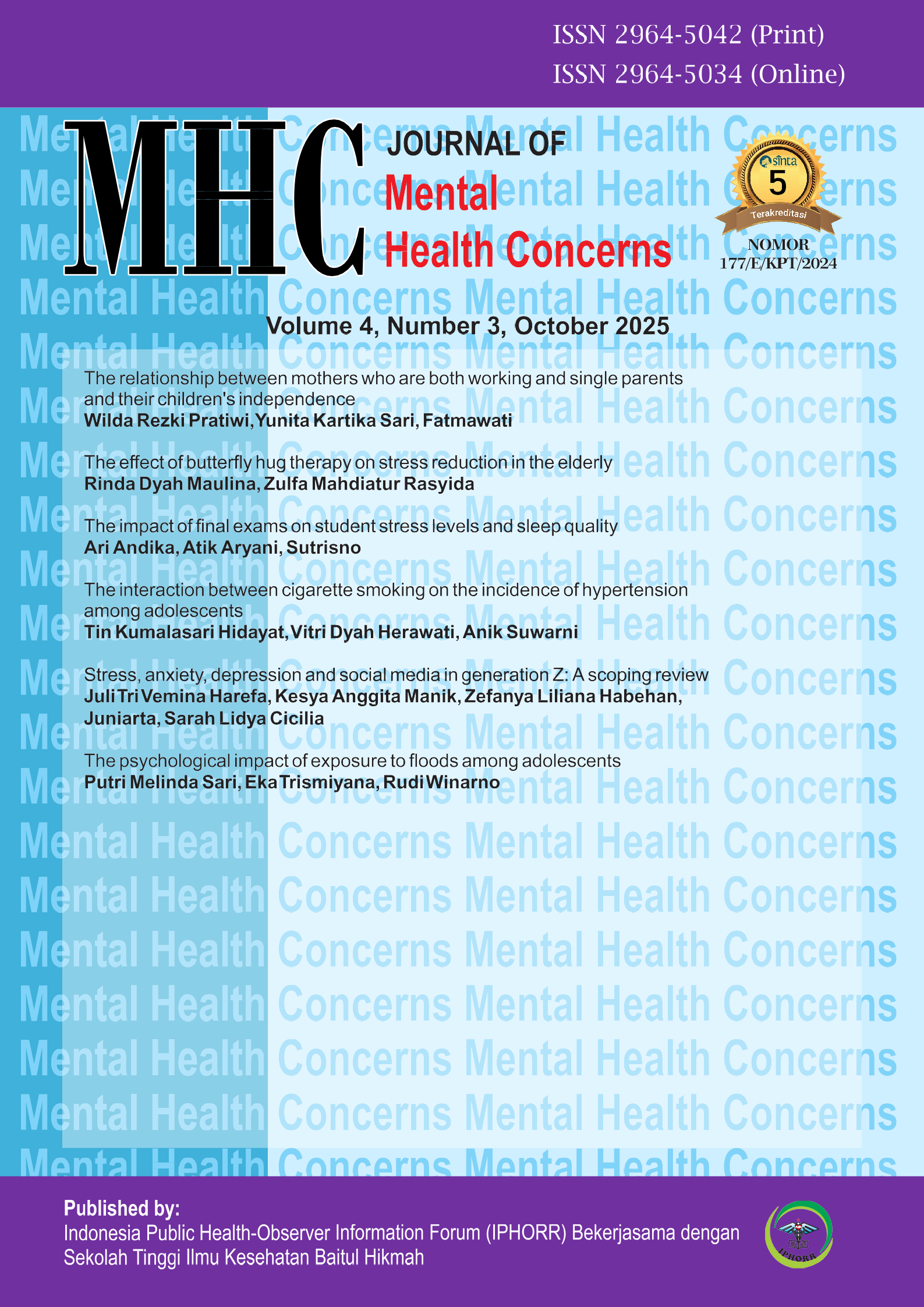
The psychological impact of exposure to floods among adolescents

DOI: https://doi.org/10.56922/mhc.v4i3.1438
Adolescents Anxiety Preparedness
Abstract
Background: Floods are the most common natural disaster in the world, dominating with 163 incidents or 50.77% in 2023. Based on the Indonesian Disaster Index (IDI) data, 8.331 flood disasters occurred in Indonesia from 2014 to 2023. Meanwhile, the National Disaster Management Agency (NDMA) recorded 16 flood incidents in the Bandar Lampung area over the past 10 years. This disaster not only causes damage to infrastructure but also instills anxiety among students, which has the potential to affect their level of preparedness. Therefore, it is very important to understand the relationship between anxiety and the preparedness of adolescents.
Purpose: To determine the psychological impact of flood exposure on adolescents.
Method: A Descriptive Correlational research type with a Cross Sectional approach, employing a quantitative method design with a Descriptive Correlation design. The respondents in this study are students at Junior High School 27 Bandar Lampung with a population of 469 students. The total sample obtained using Proportionate Stratified random sampling technique is 216 respondents.
Results: Out of 87 students with anxiety, there were 78 (89.7%) respondents who were not prepared and 9 (10.3%) respondents who were prepared to face floods. Meanwhile, out of 129 respondents without anxiety, there were 80 (62.0%) respondents who were not prepared and 49 (38.0%) respondents who were prepared to face flood disasters. The chi-square test results showed a p-value of 0.000 < 0.05.
Conclusion: Adolescence, as a dynamic transitional phase, is a crucial period for developing awareness, resilience, and preparedness in the face of disasters such as floods. Findings indicate a significant relationship between anxiety and preparedness, with adolescents experiencing anxiety being five times more likely to be unprepared than those without anxiety.
Keywords: Adolescents; Anxiety; Preparedness.
Downloads
References
Anitasari, B. (2024). Trauma Healing Pascabencana Banjir Bandang di Pengungsian. Penerbit NEM.
Devi, A. S., & Hermawati, H. (2024). Gambaran Tingkat Kecemasan Warga di Daerah Rawan Bencana Banjir Desa Laban Kabupaten Sukoharjo. Jurnal Medika Nusantara, 2(3), 229-242.
Haristiani, R., Setioputro, B., Yunanto, R. A., Al Alawi, R. I., & Zahra, A. (2023). Peningkatan pengetahuan kesiapsiagaan bencana banjir melalui edukasi video animasi dan simulasi di smpn 3 ambulu jember. Dedikasi saintek jurnal pengabdian masyarakat, 2(1), 26-35.
Istihora, S. K., & Basri, A. H. (2020). Buku Ajar Keperawatan Gawat Darurat “Kesiapsiagaan Bencana Banjir”. Jakad Media Publishing.
Marlina, H. (2024). Analisis Data Geospasial dalam Menentukan Kebutuhan Pelatihan Water Rescue untuk Menghadapi Bencana Banjir: Studi pada Rescuer di Lingkungan Basarnas. Prosiding PITNAS Widyaiswara, 1, 215-226.
Mishra, S., & Suar, D. (2022). Effects of anxiety, disaster education, and resources on disaster preparedness behavior. Journal of Applied Social Psychology, 42(5), 1069-1087.
Noor, R. (2018). Hubungan antara kontrol diri dengan perilaku seksual remaja pada siswa SMK istiqomah Muhammadiyah 4 Samarinda. Motiva: Jurnal Psikologi, 1(1), 10-15.
Nurpambudi, R., & Aziz, R. A. (2022). Prediksi Kejadian Banjir Di Wilayah Kota Bandar Lampung Dengan Metode Artificial Neural Network. In Prosiding Seminar Nasional Darmajaya (Vol. 1, pp. 93-104).
Philip, N. A., & Vithya, V. (2023). Impact of flooding on mental health and resilience of adolescents in Kerala, India. International journal of disaster risk reduction, 96, 103926.
Rahim, A., Rifai, A., Soleha, A., Fauziah, H. J., & Syain, M. (2023). Peran Pemerintah Daerah dalam Penaggulangan Bencana Banjir Menurut Peraturan Daerah Kabupaten Indramayu No. 3 Tahun 2016. JIIP (Jurnal Ilmiah Ilmu Pendidikan), 6, 2160-2163.
Rahmawaty, P., & Zulkifli, Z. (2021). Kecemasan pada mahasiswa tingkat akhir dalam mencari peluang kerja di masa pandemi covid-19 di Kota Balikpapan. Prosiding Snitt Poltekba, 5, 305-312.
Ramie, A. (2022). Mekanisme Koping, Pengetahuan Dan Kecemasan Ibu Hamil Pada Masa Pandemi Covid-19. Deepublish.
Sakdiah, H., & Zuhra, N. (2022). Tingkat Kesiapsiagaan Masyarakat dalam Menghadapi Bencana Banjir di Gampong Dayah Usen Kecamatan Meurah Dua Kabupaten Pidie Jaya. Serambi Konstruktivis, 4(1), 249-259.
Sari, N., Neherta, M., & Fajria, L. (2020). Faktor Penyebab Orang Tua Melakukan Kekerasanpada Anaknya. Penerbit Adab.
Sarkawi, M., & Fitriani, D. R. (2021). Hubungan Kecemasan dengan Kesiapsiagaan Remaja dalam Menghadapi Banjir di Samarinda. Borneo Studies and Research, 2(3), 1547-1552.
Selvyana, N. A., & Fitriani, D. R. (2021). Hubungan pengalaman dengan kesiapsiagaan remaja dalam menghadapi banjir di Samarinda. Borneo Studies and Research, 2(3), 1845-1854.
Septiana, T., arif Muda, M., & Muhammad, M. A. (2022). Pemanfaatan SIG untuk Mengurangi Risiko Bencana Banjir di Kota Bandar Lampung. Electrician: Jurnal Rekayasa dan Teknologi Elektro, 16(3), 359-364.
Simbolon, S., Rohmah, U. N., Siregar, H. K., Sugiarto, A., Nurhusna, N., Pragholapati, A., & Nugroho, W. (2023). Keperawatan bencana dan kegawatdaruratan. Yayasan Kita Menulis.
Syofyan, Z. (2022). Kolam Retensi Sebagai Upaya Pengendalian Banjir Pada Daerah Aliran Sungai Batang Pangian. Rang Teknik Journal, 5(1), 124-136.
Yusfarani, D. (2021). Hubungan Kecemasan dengan Kecendrungan Psikosomatis Remaja Pada Pandemi Covid 19 Di Kota Palembang. Jurnal Ilmiah Universitas Batanghari Jambi, 21(1), 295-298.
Downloads
Published
Issue
Section
License
Copyright (c) 2025 JOURNAL OF Mental Health Concerns

This work is licensed under a Creative Commons Attribution-NonCommercial-NoDerivatives 4.0 International License.