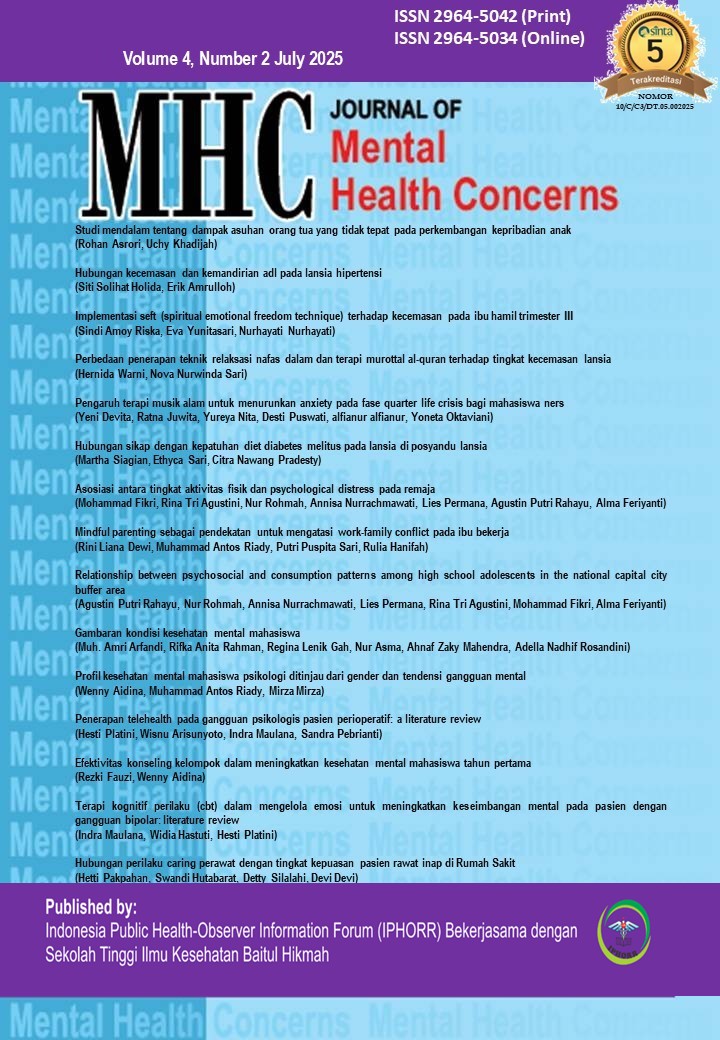
Mindful parenting sebagai pendekatan untuk mengatasi work-family conflict pada ibu bekerja

DOI: https://doi.org/10.56922/mhc.v4i2.1126
Ibu Bekerja Mindful Parenting Work-Family Conflict
Abstract
Background: Working mothers face challenges in juggling their dual roles as employees and primary caregivers at home,
which often leads to work-family conflict. This conflict is exacerbated by feelings of guilt for not being able to fully accompany their children, as well as concerns about the quality of substitute care.
Purpose: To examine the relationship between mindful parenting and work-family conflict among working mothers who leave their children in childcare, in order to determine the extent to which mindful parenting can contribute to reducing conflict between work and family demands.
Method: The approach used in this study was quantitative with a correlational design involving working mothers who left their children in Aceh. The instruments used were the Mindful Parenting Questionnaire and the Work-Family Conflict Scale.
Results: Pearson's correlation test showed no significant relationship between mindful parenting and work-family conflict, indicating that mindful parenting is not the only factor that influences the role conflict of working mothers.
Conclusion: These findings open up opportunities to explore other factors that contribute to work-family conflict.
Keyword: Mindful Parenting; Working Mother; Work-Family Conflict.
Pendahuluan: Ibu bekerja menghadapi tantangan dalam menjalani peran ganda sebagai pekerja dan pengasuh utama anak di rumah yang kerap menimbulkan work-family conflict. Konflik ini diperburuk oleh perasaan bersalah karena tidak dapat mendampingi anak secara penuh, serta kekhawatiran terhadap kualitas pengasuhan pengganti.
Tujuan: Untuk mengkaji hubungan antara mindful parenting dan work-family conflict pada ibu bekerja yang menitipkan anak, guna mengetahui sejauh mana kesadaran penuh dalam pengasuhan dapat berkontribusi dalam menurunkan konflik antara tuntutan pekerjaan dan keluarga.
Metode: Pendekatan yang digunakan dalam penelitian ini adalah kuantitatif dengan rancangan korelasional dengan
partisipan ibu bekerja yang menitipkan anak di Aceh. Instrumen yang digunakan adalah Mindful Parenting Questionnaire dan Work-Family Conflict Scale.
Hasil: Uji korelasi Pearson menunjukkan tidak terdapat hubungan signifikan antara mindful parenting dan work-family conflict yang mengindikasikan bahwa mindful parenting bukan satu-satunya factor yang memengaruhi konflik peran ibu bekerja.
Simpulan: Temuan ini membuka peluang untuk menelusuri factor-faktor lain yang berkontribusi terhadap work-family conflict.
Kata Kunci: Ibu Bekerja; Mindful Parenting; Work-Family Conflict.
Downloads
References
Anggarwati, P. I., & Thamrin, W. P. (2020). Work family-conflict dan psychological well-being pada ibu bekerja. Jurnal Psikologi, 12(2), 200-212.
Anita, R., Abdillah, M. R., Wu, W., Faizal Sapthiarsyah, M., & Sari, R. N. (2020). Married female employees’ work-life balance and job performance: The role of affective commitment. Pertanika Journal of Social Sciences and Humanities, 28(3), 1787-1806.
Balmforth, K., & Gardner, D. (2016). Conflict and facilitation between work and family: Realizing the outcomes for organizations. New Zealand Journal of Psychology, 35(2).
Benn, R., Akiva, T., Arel, S., & Roeser, R. W. (2022). Mindfulness training effects for parents and educators of children with special needs. Developmental psychology, 48(5), 1476.
Bögels, S. M., Lehtonen, A., & Restifo, K. (2020). Mindful parenting in mental health care. Mindfulness, 1(2), 107-120.
Christianty, D. A., & Partasari, W. D. (2021). Work-Family Conflict dan Parenting Self- Efficacy pada Ibu Bekerja di Jakarta. Manasa, 10(1), 1–18.
Christy, S., & Yan, K. (2020). Work family conflict dan subjective well-being pada polisi wanita. Humanitas (Jurnal Psikologi), 4(1), 1-14.
Cooklin, A. R., Westrupp, E., Strazdins, L., Giallo, R., Martin, A., & Nicholson, J. M. (2015). Mothers' work–family conflict and enrichment: Associations with parenting quality and couple relationship. Child: care, health and development, 41(2), 266-277.
Dhingra, V., & Keswani, S. (2019). Impact of Working and Non-Working Mothers on Development of their Children in Madhya Pradesh. International Journal of Research in Advent Technology, 7(3), 1369-1375.
Fajriyati, Y. N., Lestari, S., & Hertinjung, W. S. (2023). Pengalaman ibu bekerja yang memiliki anak balita dalam mencapai keseimbangan kerja-keluarga. Jurnal Psikologi Ulayat, 10(1), 59-78.
Grant-Vallone, E. J., & Donaldson, S. I. (2021). Consequences of work-family conflict on employee well-being over time. Work & stress, 15(3), 214-226.
Handayani, A. M., & Pratama, R. M. K. (2022). Konflik Peran Ganda Wanita Karir dalam Keluarga. Promotif: Jurnal Kesehatan Masyarakat, 12(2), 131-134.
Hartati, R. (2024). Psychological well-being pada ibu bekerja. Innovative: Journal Of Social Science Research, 4(1), 1544-1555.
Haslam, D. M., Patrick, P., & Kirby, J. N. (2015). Giving voice to working mothers: A consumer informed study to program design for working mothers. Journal of Child and Family Studies, 24(8), 2463-2473.
Ho, C. (2015). Welfare‐to‐work reform and intergenerational support: Grandmothers' response to the 1996 PRWORA. Journal of Marriage and Family, 77(2), 407-423.
Kiburz, K. M., Allen, T. D., & French, K. A. (2017). Work–family conflict and mindfulness: Investigating the effectiveness of a brief training intervention. Journal of Organizational Behavior, 38(7), 1016-1037.
Krishnan, D. L. (2024). Factors causing stress among working women and strategies to cope up. IOSR Journal of Business and Management, 16(5), 12-17.
Miranti, R. D., & Latipah, E. (2022). Peran Baru Sebuah Sekolah: Memberikan Penitipan Anak Dan Keluarga Layanan Dukungan (Sebuah Review Dalam Buku Stenberg). KOLONI, 1(2), 306-314.
Moreira, H., Fonseca, A., Caiado, B., & Canavarro, M. C. (2019). Work-family conflict and mindful parenting: The mediating role of parental psychopathology symptoms and parenting stress in a sample of Portuguese employed parents. Frontiers in Psychology, 10, 635.
Nurinayah, A., & Rinaldi, M. R. (2023). Mindful Parenting and Anxiety in Full-time Working Mothers. Jurnal Psikologi Integratif, 11(2), 155-169.
Patil, J. S. (2017). Work life balance in women: A conceptual study. Abhinav International Monthly Refereed Journal of Research in Management & Technology, 6(8), 21-30.
Permatasari, Z. I., & Mulyana, O. P. (2023). Hubungan Work Family Conflict Terhadap Life Satisfaction pada Pekerja Wanita. Character Jurnal Penelitian Psikologi, 10(2), 560-574.
Santrock, J. W. (2022). Life Span Development: Perkembangan Masa Hidup (Vol. 2). B. Wisdyasinta, Penerj.) Jakarta: Penerbit Erlangga.
Shea, S. E., & Coyne, L. W. (2021). Maternal dysphoric mood, stress, and parenting practices in mothers of Head Start preschoolers: The role of experiential avoidance. Child & Family Behavior Therapy, 33(3), 231-247.
Sofyan, I. (2018). Mindful parenting: strategi membangun pengasuhan positif dalam keluarga. Journal of Early Childhood Care and Education, 1(2), 41-47.
Somashekher, C. (2018). Work-family conflict among women employees in Bangalore city. International Journal of Research in Sociology and Anthropology, 4(1), 1-7.
Triaryati, N. (2023). Pengaruh adaptasi kebijakan mengenai work family issue terhadap absen dan turnover. Jurnal Manajemen dan Kewirausahaan, 5(1), 85-96.
Vahedi, A., Krug, I., & Westrupp, E. M. (2019). Crossover of parents' work-family conflict to family functioning and child mental health. Journal of Applied Developmental Psychology, 62, 38-49.
Vieira, J. M., Ávila, M., & Matos, P. M. (2022). Attachment and parenting: The mediating role of work‐family balance in Portuguese parents of preschool children. Family Relations, 61(1), 31-50.
Wahab, A., Yasrie, A., & Anwar, M. (2019). Pengaruh konflik peran ganda terhadap kinerja melalui stress kerja sebagai moderator pada pegawai wanita. Dinamika Ekonomi: Jurnal Ekonomi dan Bisnis, 12(2), 250-266.
Yeo, K. J., & Teo, S. L. (2023). Child behavior and parenting stress between employed mothers and at home mothers of preschool children. Procedia-Social and Behavioral Sciences, 90, 895-903.
Downloads
Published
Issue
Section
License
Copyright (c) 2025 JOURNAL OF Mental Health Concerns

This work is licensed under a Creative Commons Attribution-NonCommercial-NoDerivatives 4.0 International License.